Loading resource...
November 2, 2026
Rights of Accumulation
Welcome to the Retirement Learning Center’s (RLC’s) Case of the Week. Our ERISA consultants regularly receive calls from financial advisors on a broad array of technical topics related to IRAs, qualified retirement plans and other types of retirement savings and income plans, including nonqualified plans, stock options, Social Security and Medicare. This is where we highlight the most relevant topics affecting your business. A recent call with a financial advisor in Illinois is representative of a common question on mutual fund investments in qualified retirement plans and IRAs.
“Do rights of accumulation (ROA) apply to qualified retirement plans and/or IRA owners?”
Highlights of the Discussion
The short answer is yes, potentially. Rights of accumulation (ROA) may apply to investments held in qualified retirement plans and IRAs, but eligibility depends on the specific mutual fund family's rules, the types of accounts involved, and how the investments are held.
Before exploring this issue in more detail, it would be helpful to understand how ROA work. ROA allow investors to count existing eligible mutual fund holdings when determining the breakpoint discount on new purchases of shares subject to sales charges (typically Class A shares). These discounts generally reduce the front-end sales charge as the value of eligible investments increases.
ROA are governed by the mutual fund family's prospectus and distribution arrangements subject to applicable securities-law disclosure and sales-practice requirements and, for ERISA-covered plans, fiduciary duties. Although qualified retirement plan and IRA holdings may be eligible for aggregation, the applicable rules vary among fund families.
The following two scenarios illustrate how ROA may apply within a qualified retirement plan and when combining retirement accounts with an investor's personal holdings. See FINRA Breakpoints Checklist and FINRA Regulatory Notice 21-07 for more details.
Scenario 1: Aggregation Within a Qualified Retirement Plan
A 401(k) plan holds $2 million in ROA-eligible mutual funds from a single fund family on behalf of 100 participants. Assume the new purchases are in shares subject to a front-end sales charge. Three participants direct new investments totaling $30,000 into funds within that same family.
If the fund family permits plan-level aggregation and the purchases are eligible for breakpoints, the existing $2 million in plan holdings may qualify all three purchases for the breakpoint discount associated with the plan's aggregate investment value, even though each participant's individual account balance is substantially smaller.
Key considerations:
Does the breakpoint discount apply to eligible purchases made through the retirement plan, or is the sales charge waived?
Eligibility may depend on whether the plan trust is treated as a single purchaser, whether investments are held through an omnibus account, and whether the fund family expressly permits plan-level aggregation. Some plans instead qualify for sales-charge waivers, making ROA unnecessary for those purchases.
Plan fiduciaries should not assume that all participant holdings or all investments within a fund family automatically qualify for aggregation.
Scenario 2: Aggregation of Qualified Plan, IRA, and Personal Accounts
An investor holds the following amounts in otherwise eligible mutual funds within the same fund family:
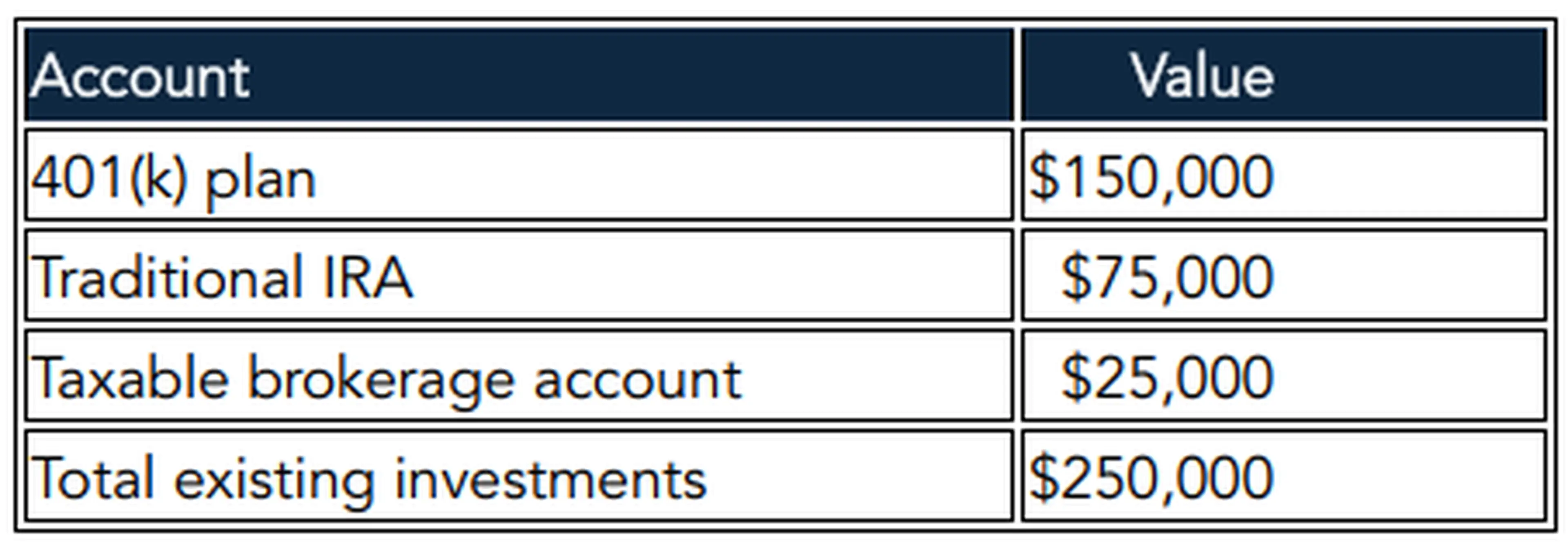
The investor plans to purchase an additional $10,000 of mutual fund shares in the taxable brokerage account and wants to know whether the existing $250,000 can be combined to determine the applicable breakpoint discount.
The answer depends on the ROA provisions of the fund family.
If the fund family permits aggregation across all three accounts: The full $250,000 in existing holdings, plus the $10,000 purchase ($260,000 total), may be considered when determining the sales charge on the new $10,000 purchase.
If the fund family excludes employer-sponsored retirement plan holdings: Only the $100,000 held in the IRA and taxable brokerage account, plus the $10,000 purchase ($110,000 total), count toward the breakpoint.
In either case, the discount applies to the investor's new personal investment rather than to a purchase made by the qualified retirement plan.
Some mutual fund families permit aggregation of IRA and other personally owned accounts, including eligible household accounts, while excluding assets held in multi-participant employer-sponsored retirement plans. Because these provisions vary, investors should review the applicable prospectus before assuming that retirement plan assets qualify.
Fiduciary Considerations
Although ROA are primarily governed by mutual fund prospectuses and distribution arrangements, their application within qualified retirement plans can raise important fiduciary considerations.
Under ERISA §404(a)(1), plan fiduciaries must act prudently and ensure that plan expenses are reasonable. When a retirement plan invests in mutual fund shares subject to sales charges, fiduciaries should consider whether available breakpoint discounts have been obtained and whether lower-cost share classes or investment alternatives are available.
However, failure to obtain a breakpoint discount does not automatically constitute an ERISA fiduciary breach. The determination depends on the relevant facts, available investment alternatives, and the fund family's specific provisions.
For individual investors, ROA are generally a matter of mutual fund disclosure requirements and broker-dealer sales practices. However, using retirement plan assets or fiduciary authority to secure personal financial benefits may raise additional ERISA concerns.
It is also important to recognize that ROA generally have limited application to no-load mutual funds, institutional share classes, and collective investment trusts that do not impose front-end sales charges.
Conclusion
ROA may be available to both qualified retirement plans and IRA owners, but eligibility is not automatic. Financial advisors and plan fiduciaries should confirm the applicable fund family's prospectus provisions, eligible account types, breakpoint schedules, aggregation procedures, and documentation requirements before determining whether a discount is available.